

DATA ON RETIREMENT IN FRANCE
Amidst the clamor and furor surrounding retirement in France, it’s easy to get lost in the noise and lose sight of the numbers. There are numerous passionate opinions on the matter, and the chorus of opinions has drowned out the data.
My initial questions were, “Why is the increase limited to two years, and not more or less?” and, “What are the alternative options?” I think life expectancy, birth rate, and tax revenue projections are of interest, but I acknowledge that I am asking too much of the population and politicians to provide these comprehensive data, so I digress.
However, there’s another, simpler set of data that could prove interesting: the average age of retirement in Europe. This idea came to me after two friends expressed their dismay at the “ungrateful French” for not being willing to work longer. One of them, to my surprise, is a friend from the French working class. The other, an American, surprised me as well, considering he often praises what he perceives as the “superiority” of the French social system. Hearing their complaints, I was curious to know when the rest of the world retires and if the French were being unreasonable in maintaining their current retirement age.
I usually avoid comparing systems. It risks comparing apples to oranges. The French system is unique, as are the systems of each nation. Retirement programs elsewhere don’t directly apply to the unique French economy and society. Nonetheless, I did some digging and came across the following graph on Twitter. It was created by the Renaissance party of France, which supports French President Emmanuel Macron and retirement reform.
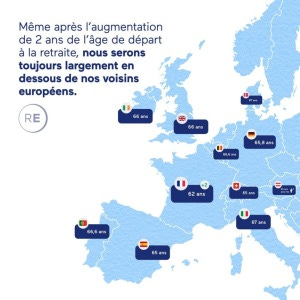
The graphic initially appeared noteworthy, suggesting that a two-year increase in France’s retirement age would still result in a lower age compared to other European countries. Upon closer examination, I noticed an inconsistency. The retirement ages in the other countries appeared to be significantly higher than I would have assumed.
This piqued my curiosity, so I sought more information. I thought about it, and considered researching the difference between the age when individuals “can” retire and the average age when they “actually” retire. These can differ substantially. I found an article from Euronews that provided a clearer understanding of the situation. The graphic, it turned out, was comparing the early retirement age in France (62 years) with actual retirement ages in several countries. This was true for Austria, Germany, Ireland, Norway, Spain, and Switzerland. In these countries, the early retirement age was lower than the graphic suggested.
In addition, the average retirement age in France today is not 62, as the graphic implies. It is actually 64.5 years. Additionally, the true retirement ages in Belgium, Italy, and Portugal are lower than the numbers displayed in the graphic. The data provided by Euronews appears to be either from 2020 or the most recent available data from the Organization for Economic Co-operation and Development (OECD). In contrast, the Renaissance graphic lacks a specific source. I conclude that it cannot be trusted as a valuable source.
My research here touches on the importance of checking sources and assumptions when discussing political topics. We can deceive ourselves or be deceived by others about the real numbers.
#retraites #retirement #france #pensions